
The Daily Pour · Week 2 · Recipe Formulation
Barrel School · Monday, November 16, 2026
The Mash Bill: Bourbon's Recipe
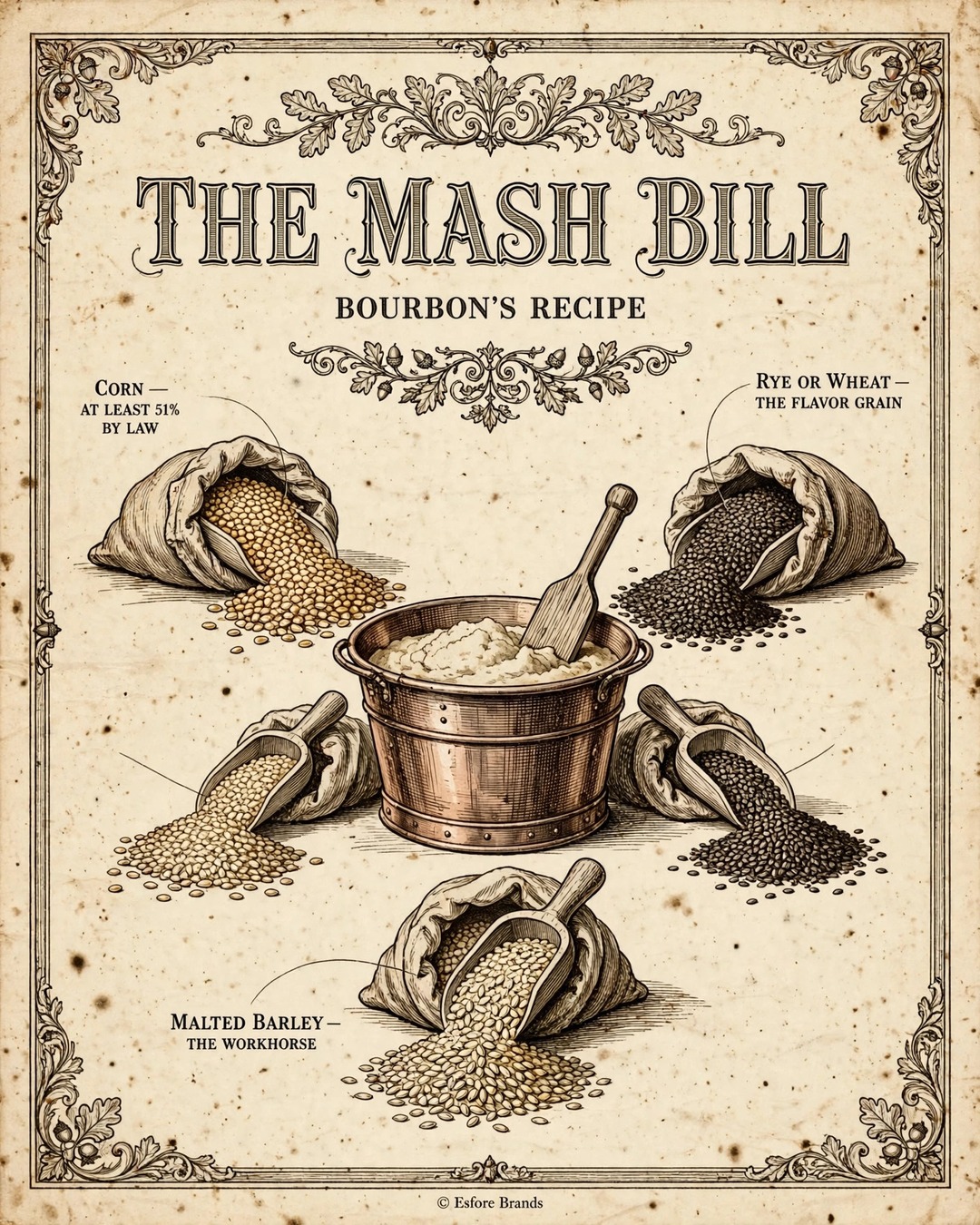
Ask a distiller what makes their bourbon theirs, and they'll start with the mash bill — the grain recipe. It's the list of grains and the percentage of each that goes into the fermenter, and it's the first fork in the road for every bottle.
Federal law writes exactly one line of that recipe. Under 27 CFR 5.143, bourbon must be made from a fermented mash of at least 51 percent corn. The rest — up to 49 percent of the grain — is the distiller's choice: rye or wheat as the flavor grain, plus a small share of malted barley whose enzymes convert the grain starches into fermentable sugar. The law also caps distillation at 160 proof, barrel entry at 125 proof, and bottling at no less than 80 proof — but the grain ratio is where the flavor story starts.

That open 49 percent sorts bourbon into three families. The traditional recipe — sometimes called a rye recipe — runs corn in the high 70s with rye in the low teens, a gentle spice riding under the corn's sweetness. High-rye bourbons push the rye up to roughly 20 to 35 percent, pulling corn down to make room; Bulleit runs 68 percent corn, 28 percent rye, and 4 percent malted barley, and Four Roses' high-rye mash bill B is 60 percent corn, 35 percent rye, 5 percent malted barley. Wheated bourbons swap the rye out entirely for wheat: Maker's Mark runs 70 percent corn, 16 percent red winter wheat, 14 percent malted barley, and the same wheated family holds W.L. Weller and Pappy Van Winkle.
Same legal minimum, same new charred oak, same Kentucky limestone water — and three different drinks. The mash bill doesn't decide everything; yeast, water, the still, and the warehouse all get their say later. But it decides the first thing you taste: whether the glass leans sweet and round, or spicy and sharp.
This week, The Daily Pour cooks through the recipe: corn, the flavor grain, yeast, and limestone water — then a tasting at the bench, so you can taste the difference a second grain makes.
The Daily Pour is Esfore' Brands' daily bourbon lesson — a new lesson every day on Instagram @esfore_brands, and the full story here on the blog. Good Bourbon, Good People, Great Stories. That's a Good Pour! – Coop
← Previous lesson: Anatomy of a Barrel: The Week in Review · Next lesson: Corn: The Backbone →